Unsupported Browser: Some features may not work properly in Internet Explorer. Please use one of the supported browsers - Chrome, Firefox, Safari, Microsoft Edge.

-
HOW DO I
Apply For
Find
Pay
View
Join
Water Testing

-
RESIDENTS
Health & Wellness
Senior & Assisted Living
Environment
Families & Individual Support
Financial Assistance
Library
Safety & Justice
Broadband
-
BUSINESS
Community Development
GIS Mapping
Landfill
Ordinances
Requests For Proposals
Start A Business
Zoning, Planning & Land Information
Broadband
-
VISITORS
Campgrounds & Shelters
Downtown Guide
Hunting & Fishing
Parks/Facilities
Explore La Crosse
-
YOUR GOVERNMENT
County Board
Ordinances
Resolutions
Elections
Elected Officials
State
Federal
Facilities
Municipalities: Cities, Villages and Towns
School Districts


Emergency Services
The History of 911
A single number for help
Before 911, there was no single nationwide emergency number. People often had to know the local phone number for police, fire, or an ambulance service, and in an emergency that cost valuable time. In 1966, the National Academy of Sciences recommended exploring a single national number to summon emergency medical help. Two years later, AT&T designated 911 as the universal emergency number, and on February 16, 1968, the first 911 call in the United States was placed in Haleyville, Alabama. Although 911 began spreading after that first call, Congress did not formally establish 911 as the nation’s emergency number until the Wireless Communications and Public Safety Act of 1999.
The early years of 911
The earliest 911 systems were basic by today’s standards. A caller could reach emergency help more quickly, but dispatchers often had to ask for the caller’s number, exact location, and the nature of the emergency before they could send police, fire, or EMS. As local governments and telephone providers expanded service, communities began moving from Basic 911 to Enhanced 911 (E911), which allowed dispatchers to receive a caller’s phone number and address automatically for many landline calls. That change made emergency response faster, more accurate, and more consistent.
From landlines to wireless 911
The rise of cell phones changed emergency communications again. Landline 911 relied on a fixed service address, but mobile phones do not stay in one place. In 1996, the Federal Communications Commission adopted wireless E911 rules to improve how emergency calls from mobile devices were handled and to require better location information for wireless callers. That shift was a major turning point, because 911 centers had to adapt to a world where callers might not know where they were, might be calling from a highway or rural area, and might be indoors where location is harder to pinpoint.
The move toward Next Generation 911
The next major step in 911 history is Next Generation 911 (NG911). Beginning in the early 2000s, national work on NG911 focused on moving emergency communications from legacy analog systems to secure digital, IP-based networks. NG911 is designed to support not only voice calls, but also improved location data and newer forms of information sharing between the public, telecommunicators, and responding agencies. In practical terms, NG911 is about building a more resilient and flexible emergency communications system for the way people communicate now.
911 in Wisconsin
Wisconsin law makes 911 the primary emergency telephone number within emergency telephone systems established in the state. Over time, Wisconsin has moved from traditional county-based 911 operations toward a more coordinated statewide framework for modern emergency communications. The state’s emergency communications structure now includes support for interoperability and NG911 development, and Wisconsin’s Office of Emergency Communications was created under the Department of Military Affairs in 2017 to help lead that effort.
Wisconsin’s modernization work has continued in recent years. Ongoing work on a statewide NG911 system includes the Emergency Services IP Network (ESInet), GIS and call-routing standards, and an operational-date process for counties transitioning to NG911.
911 in La Crosse County
After years of study and preparation, La Crosse County began using 911 in January 1983. At the same time, local law enforcement and fire agencies combined dispatching functions to create the La Crosse Emergency Dispatch Center, giving the public one number to call and a more coordinated system for getting help to the right place.
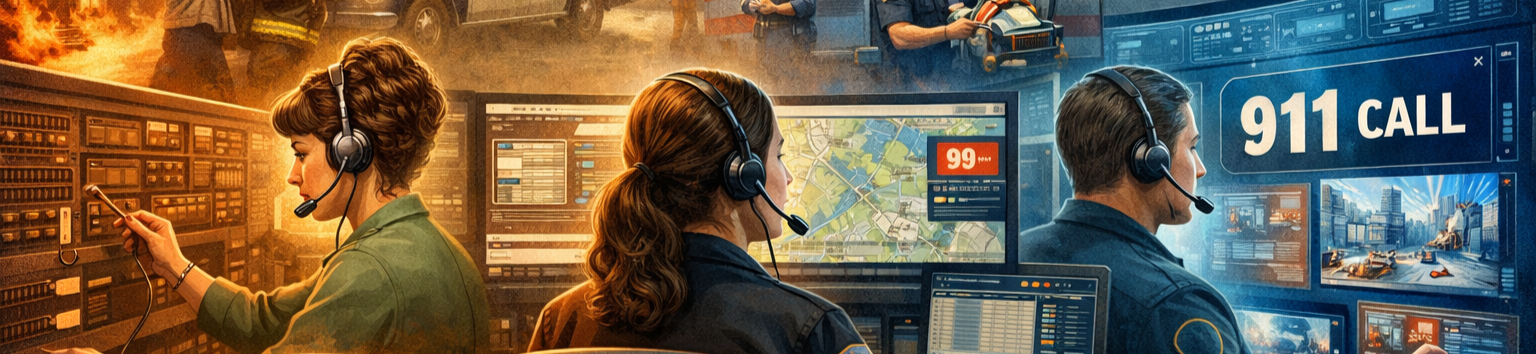
The original center was located in the basement of the County Courthouse and had room for three dispatchers working at one time. Each position included radio and phone equipment, and dispatchers shared computer resources for local, state, and national data. Calls for service were entered manually on cards, and times and case numbers were hand stamped. That setup reflects how much emergency communications has changed over the last four decades.
In 1989, the center was remodeled to add another console position and additional computer systems, including La Crosse’s first Computer Aided Dispatch (CAD) system. In 1998, the Communications Center moved to the La Crosse County Courthouse and Law Enforcement Center. In 2003, La Crosse County Emergency Management was combined with the dispatch center to form La Crosse County Emergency Services, and the dispatch center became known as Public Safety Communications.
La Crosse County’s history mirrors the broader national story of 911: what began as a voice-based emergency number supported by local phone and radio systems has grown into a highly technical public safety function that depends on trained telecommunicators, interoperable communications, mapping, CAD, records systems, artificial intelligence, and increasingly digital 911 infrastructure. The mission, however, has remained the same: when someone in La Crosse County needs help, one call should connect them to the right emergency response as quickly as possible.
Looking ahead
The history of 911 is still being written. Nationally and in Wisconsin, emergency communications continue to evolve toward NG911, stronger interoperability, and more accurate location information for callers using mobile and internet-connected devices. For La Crosse County, that larger history is not abstract. It is part of the daily work of answering calls, coordinating responders, and continuing to modernize the systems the public relies on during their worst moments.
© 2026 La Crosse County. All Rights Reserved.